
Bajaj Life Supreme

What Is Bajaj Life Supreme?
Bajaj Life Supreme is a Unit-Linked, Non-Participating, Individual Life Savings Insurance Plan. It combines two elements within one policy: life insurance protection and market-linked investment. A part of the policy value is invested in the selected unit-linked funds, while life cover remains available during the policy term, subject to the policy remaining in force.
The plan is available in different variants, including Gold and Horizon. The main difference lies in how premium allocation charges and certain additions to the fund are structured. Since this is a ULIP, the investment returns are not fixed or guaranteed. The value of the investment may increase or decrease depending on the performance of the selected funds and the capital markets. The investment risk is borne by the policyholder. The plan also carries the mandatory five years ULIP lock in period, during which complete or partial withdrawal of the invested money is not permitted.
Eligibility for Bajaj Life Supreme Plan
Before selecting gold or horizon variant, it is important to check whether the entry age, maturity age, premium payment period and policy term match your financial objective. You should also consider the minimum premium commitment and the amount of life cover available in relation to the premium.
The eligibility conditions are the same for the Gold and Horizon variants. The difference between these variants begins primarily with their premium allocation charge and fund-addition structure rather than their entry or maturity conditions. Check the eligibility as mentioned below:
All ages under the plan are calculated according to the policyholder’s or life assured’s age as on the last birthday.
Quarterly and monthly premium-payment frequencies are available through auto-debit arrangements approved by the Reserve Bank of India.
Minimum Premium Requirements
The minimum premium requirements are also identical in both variants.
Under the Premium Mode, the minimum premium for both Gold and Horizon plans is ₹12,000 for annual regular or limited pay, ₹6,000 for half-yearly regular or limited pay, ₹4,000 for quarterly regular or limited pay, and ₹1,000 for monthly regular or limited pay. For single premium, the minimum premium is ₹20,000 for both Gold and Horizon, while the minimum top-up premium is ₹5,000 for both plans. There is no stated maximum premium limit; the maximum premium is subject to the insurer’s Board Approved Underwriting Policy.
The absence of a stated maximum premium does not mean that every proposed premium or sum assured will automatically be accepted. The final acceptance may depend on the insurer’s underwriting rules, financial eligibility and other applicable conditions.
Minimum Sum Assured
The minimum life cover depends on the age at entry and the selected premium-payment method.
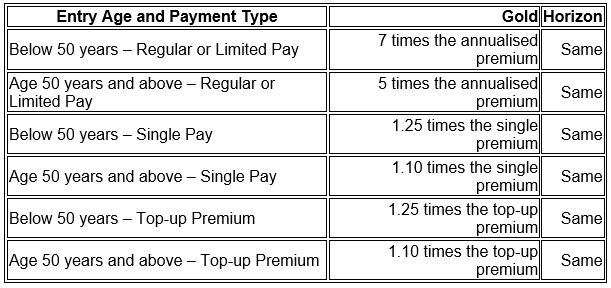
These are minimum multipliers stated in the leaflets. The actual sum assured available to a customer may also depend on the chosen policy term, premium amount, age and the insurer’s underwriting decision.
Maximum Sum Assured
For policy terms of 15, 20, 25, 30 or 40 years, the maximum regular-premium sum assured is linked to the age at entry.
The Maximum Regular-Premium Sum Assured depends on the policyholder’s age at entry. For ages 0 to 30 years, the maximum sum assured is 30 times the annualised premium. For ages 31 to 40 years, it is 25 times the annualised premium, while for ages 41 to 45 years, it is 15 times the annualised premium. For ages 46 to 60 years, the maximum sum assured is 10 times the annualised premium. For ages 61 to 70 years, regular premium is not available for these policy terms.
For single premiums and top-up premiums, the maximum sum assured is stated as 1.25 times the respective single or top-up premium. For the Whole Life policy term, the maximum sum assured is:
The Maximum Sum Assured varies based on the premium type. For Regular or Limited Pay, the maximum sum assured is 10 times the annualised premium. For Single or Top-up Premium, the maximum sum assured is 1.25 times the single or top-up premium.
These maximum limits are the same under Gold and Horizon.
Gold vs Horizon: What Is the Main Difference?
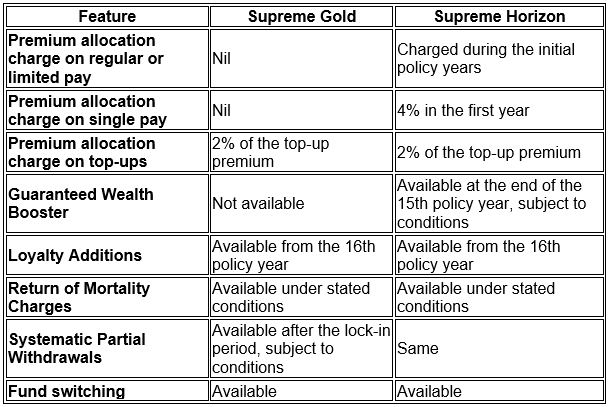
Although Gold and Horizon have the same eligibility and core insurance benefits, their treatment of premium allocation charges is different.
Supreme Gold Variant
The Gold variant has no premium allocation charge for regular pay, limited pay or single pay. This means the policy does not deduct an allocation charge from these base premiums before investing them. However, a charge of 2% applies to top-up premiums.
Gold may be more straightforward for a customer who prefers not to have an upfront premium allocation charge on the base premium. It still provides the common Bajaj Life Supreme features, including market-linked investment, loyalty additions, return of mortality charges, fund switching and systematic partial withdrawals.
Supreme Horizon Variant
Horizon deducts a premium allocation charge during the initial policy years.
For regular or limited pay with annual premium frequency, the charge is 12% in the first year, 4.5% in the second and third years, and 4% in the fourth and fifth years. For non-annual frequencies, it is 9% in the first year, 4.5% in the second and third years, and 3% in the fourth and fifth years. No premium allocation charge applies from the sixth year onwards. A 4% charge applies to single pay in the first year, while top-up premiums carry a 2% charge.
The distinguishing benefit under Horizon is the Guaranteed Wealth Booster. The premium allocation charges deducted during the policy term are accumulated at a guaranteed rate of 7% per annum, compounded annually, and added to the fund value at the end of the 15th policy year in the form of additional units.
However, this should not be misunderstood as a guaranteed 7% return on the entire investment. The 7% guaranteed accumulation applies only to the eligible premium allocation charges that were deducted. The remaining policy fund continues to be market-linked.
The Wealth Booster is not available if the policy is surrendered, discontinued or converted into a paid-up policy before the applicable benefit date. It also does not apply to premium allocation charges deducted from top-up premiums.
Therefore, the Horizon leaflet describes the variant as having an “effectively zero premium allocation charge,” but this does not mean that no charge is deducted initially. The charges are first deducted and are subsequently added back at the end of the 15th year with the specified compounding growth, provided the policy remains in force and the applicable conditions are met.
Key Advantages of Bajaj Life Supreme
Potential for Market-Linked Wealth Creation
The policyholder can invest in market-linked funds offered under the plan. The available options include equity funds, index funds, small-cap and mid-cap funds, asset-allocation funds, liquid funds and debt funds.
This gives the policyholder the opportunity to select funds according to the investment horizon and risk tolerance. However, returns are not assured, and the fund value will depend on market performance.
Life Insurance Protection
The plan provides life cover throughout the selected policy term, subject to the policy remaining in force and all applicable terms being fulfilled.
The cost of life insurance protection is deducted through mortality charges. These charges depend on factors such as the life assured’s age, gender, selected sum assured and the insurer’s underwriting policy.
Loyalty Additions From the 16th Policy Year
Under both Gold and Horizon, Loyalty Additions are credited at the end of every year beginning from the 16th policy year and continuing until the end of the policy term.
The Loyalty Addition is calculated as 0.25% of the average fund value of the previous three years, including the current policy year. The additional units are added to the fund in the same proportion in which the existing fund value is invested.
Loyalty Additions are not applicable to top-up premiums or the top-up fund value. They are also not available if the policy is surrendered, discontinued or converted into a paid-up policy.
Return of Mortality Charges
Both variants provide for the return of eligible mortality charges in the form of additional units.
At the end of the 15th policy year, 100% of the eligible mortality charges deducted up to that point are added back to the fund. Thereafter, mortality charges deducted during the previous five policy years are returned at every fifth policy year before maturity. At maturity, the remaining eligible mortality charges that have not already been returned are added back.
The return does not include extra mortality charges, applicable GST, cess or other taxes charged on the mortality cost. It is also not available when the policy is surrendered, discontinued or converted to paid-up status.
Systematic Partial Withdrawals
After completion of the five-year lock-in period, the policyholder may use the systematic partial withdrawal facility, subject to the terms and conditions of the policy.
This facility may help create a periodic secondary income from the accumulated fund value. However, every withdrawal reduces the remaining fund value and may affect the amount available for future goals, maturity or death benefits.
Fund-Switching Facility
The policy allows the policyholder to switch money between available funds. This may help in adjusting the portfolio according to changing financial goals, market conditions or risk appetite.
The leaflet describes fund switching as tax-free, but actual tax treatment will depend on the tax laws prevailing at the relevant time. Policyholders should obtain independent tax advice before relying on any tax benefit.
Flexible Policy and Premium Terms
The plan provides fixed policy-term options of 15, 20, 25, 30 and 40 years, along with a Whole Life option. Customers can choose regular pay, limited pay or single pay, subject to age and eligibility conditions.
This flexibility allows the premium commitment and policy duration to be aligned with goals such as retirement, education funding or long-term wealth transfer.
Maturity Benefit
If the life assured is alive on the maturity date, the available fund value is paid as the maturity benefit.
The policyholder may receive the maturity benefit as a single lump-sum payment or choose the Settlement Option, under which the benefit can be received systematically for a maximum period of five years.
The maturity value is not predetermined because it depends on factors such as premiums invested, selected funds, market performance, applicable charges, additions credited, withdrawals and fund switches made during the policy term.
Death Benefit
If the life assured dies during the policy term while the policy is in force and all due premiums have been paid, the death benefit will be the highest of:
- The prevailing Sum Assured, including the top-up Sum Assured, where applicable.
- The Fund Value available on the date the insurer is informed of the death.
- The guaranteed minimum death benefit of 105% of the total eligible premiums paid up to the date of death, including applicable top-up premiums.
The policy terminates after the death claim becomes payable.
The term “total premiums paid” refers to the base premiums paid under the policy and excludes explicitly collected extra premiums and taxes.
Important Charges Under the Plan
Policy Administration Charge
For regular and limited-pay policies, the policy administration charge is 0.09% of the annualised premium during the first five policy years and 0.20% during the sixth to twentieth policy years. No policy administration charge applies from the 21st policy year onwards.
For single-pay policies, the charge is 0.05% of the single premium during the applicable period and becomes nil from the 21st policy year onwards.
The charge is deducted monthly by cancelling units at the prevailing unit price. The leaflet states that the charge is currently capped at ₹500 per month, subject to limits permitted by IRDAI from time to time.
Fund Management Charge
The fund management charge depends on the selected fund and is adjusted in the NAV daily.
The charges mentioned in the leaflets range from 0.50% per annum for the Sustainable Equity Fund to 1.35% per annum for several equity, index and market-linked funds. Debt-oriented funds such as the Bond Fund, Individual Short Term Debt Fund and Debt Plus Fund carry a charge of 0.95% per annum.
Mortality Charge
Mortality charge is the cost of providing the life insurance cover. It depends on the life assured’s age, gender, chosen sum assured and underwriting outcome.
The charge is deducted every month by cancelling units from the policy fund. Although eligible mortality charges may later be returned under the Return of Mortality Charges feature, extra mortality charges and taxes are excluded from the return.
Miscellaneous Charge
A miscellaneous charge of ₹100 per transaction may apply to transactions specified in the policy terms. It is deducted by cancelling units from the fund.
Applicable GST, cess and other taxes are charged separately on the relevant policy charges.
Important Points to Understand Before Buying
Bajaj Life Supreme is primarily designed for long-term financial planning. The five-year lock-in means the invested amount cannot be completely or partially withdrawn during the first five years.
The value of the policy is linked to the capital markets. Neither the name of the plan nor the name of any fund indicates or guarantees the quality of the investment, future performance or returns.
The 4% and 8% returns shown in the sample illustrations are only assumed rates used to explain how the policy may work. They are not minimum or maximum returns and are not guaranteed outcomes.
Features such as Loyalty Additions, Return of Mortality Charges and the Horizon Guaranteed Wealth Booster are linked to specific conditions. Surrendering, discontinuing or converting the policy into paid-up status may result in the loss of some of these additions.
Overall Understanding
Bajaj Life Supreme is a long-term ULIP that provides market-linked investment along with life insurance cover. Gold and Horizon share the same eligibility, life cover structure, policy terms, premium options, maturity benefit and death benefit.
The Gold variant offers a simpler allocation-charge structure because there is no premium allocation charge on regular, limited or single premiums.
The Horizon variant deducts allocation charges during the initial years but accumulates eligible deducted charges at 7% per annum and adds them back at the end of the 15th policy year through the Guaranteed Wealth Booster, subject to the policy remaining eligible.
The final choice between Gold and Horizon should therefore be based on whether the customer prefers no base premium allocation charge from the beginning or is comfortable with the Horizon charge-and-booster structure while remaining invested for at least 15 years.
Who Is Bajaj Life Supreme For?
Bajaj Life Supreme may be considered by people who want to build wealth over a long period while maintaining life insurance protection under the same policy.
It may be suitable for individuals planning for long-term financial goals such as a child’s higher education, home purchase, retirement planning, wealth creation or legacy planning. Its policy terms extend from 15 years to whole life, making it more relevant for people who can remain invested for a long duration.
The plan may also be useful for individuals who want the flexibility to choose from equity, debt, index, asset-allocation and other market-linked funds based on their investment preferences and risk appetite.
However, this plan may not be suitable for someone who needs guaranteed investment returns, short-term liquidity or easy access to the invested money during the first five years. It is also important to understand that the life cover under a ULIP may not always be as high as the coverage available under a pure term insurance plan for the same premium.

5.0
Need advice from experts?
Life is uncertain. Your protection shouldn't be, Book your call now.
Eligibility for Bajaj Life Supreme Plan
Before selecting gold or horizon variant, it is important to check whether the entry age, maturity age, premium payment period and policy term match your financial objective. You should also consider the minimum premium commitment and the amount of life cover available in relation to the premium.
The eligibility conditions are the same for the Gold and Horizon variants. The difference between these variants begins primarily with their premium allocation charge and fund-addition structure rather than their entry or maturity conditions. Check the eligibility as mentioned below:
All ages under the plan are calculated according to the policyholder’s or life assured’s age as on the last birthday.
Quarterly and monthly premium-payment frequencies are available through auto-debit arrangements approved by the Reserve Bank of India.
Minimum Premium Requirements - The minimum premium requirements are also identical in both variants.
Under the Premium Mode, the minimum premium for both Gold and Horizon plans is ₹12,000 for annual regular or limited pay, ₹6,000 for half-yearly regular or limited pay, ₹4,000 for quarterly regular or limited pay, and ₹1,000 for monthly regular or limited pay. For single premium, the minimum premium is ₹20,000 for both Gold and Horizon, while the minimum top-up premium is ₹5,000 for both plans. There is no stated maximum premium limit; the maximum premium is subject to the insurer’s Board Approved Underwriting Policy.
The absence of a stated maximum premium does not mean that every proposed premium or sum assured will automatically be accepted. The final acceptance may depend on the insurer’s underwriting rules, financial eligibility and other applicable conditions.
Minimum Sum Assured - The minimum life cover depends on the age at entry and the selected premium-payment method.
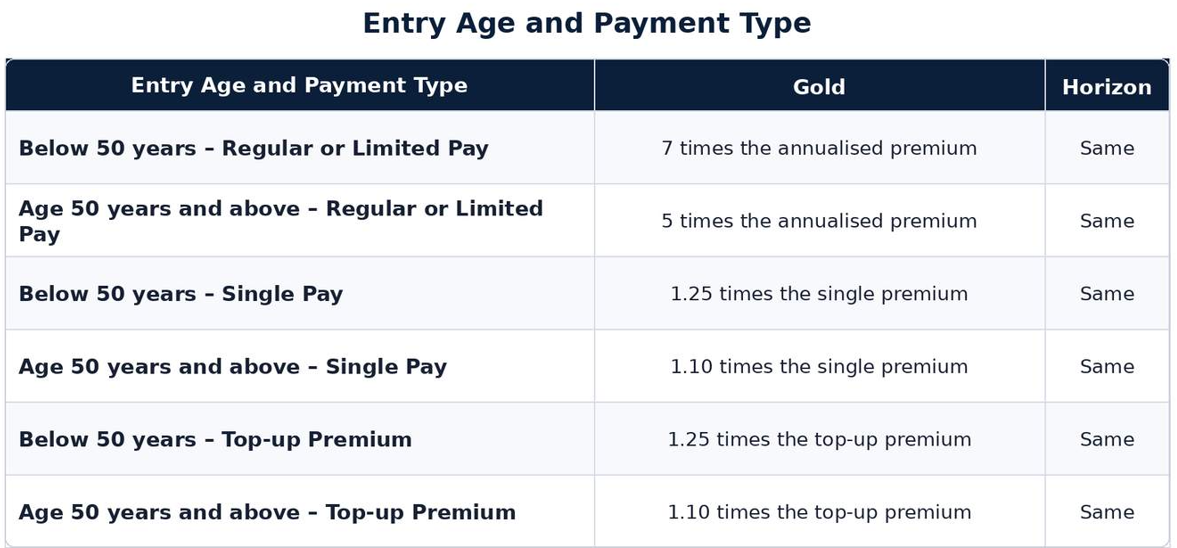
These are minimum multipliers stated in the leaflets. The actual sum assured available to a customer may also depend on the chosen policy term, premium amount, age and the insurer’s underwriting decision.
Maximum Sum Assured - For policy terms of 15, 20, 25, 30 or 40 years, the maximum regular-premium sum assured is linked to the age at entry.
The Maximum Regular-Premium Sum Assured depends on the policyholder’s age at entry. For ages 0 to 30 years, the maximum sum assured is 30 times the annualised premium. For ages 31 to 40 years, it is 25 times the annualised premium, while for ages 41 to 45 years, it is 15 times the annualised premium. For ages 46 to 60 years, the maximum sum assured is 10 times the annualised premium. For ages 61 to 70 years, regular premium is not available for these policy terms.
For single premiums and top-up premiums, the maximum sum assured is stated as 1.25 times the respective single or top-up premium. For the Whole Life policy term, the maximum sum assured is:
The Maximum Sum Assured varies based on the premium type. For Regular or Limited Pay, the maximum sum assured is 10 times the annualised premium. For Single or Top-up Premium, the maximum sum assured is 1.25 times the single or top-up premium.
These maximum limits are the same under Gold and Horizon.
Gold vs Horizon: What Is the Main Difference?
Although Gold and Horizon have the same eligibility and core insurance benefits, their treatment of premium allocation charges is different.
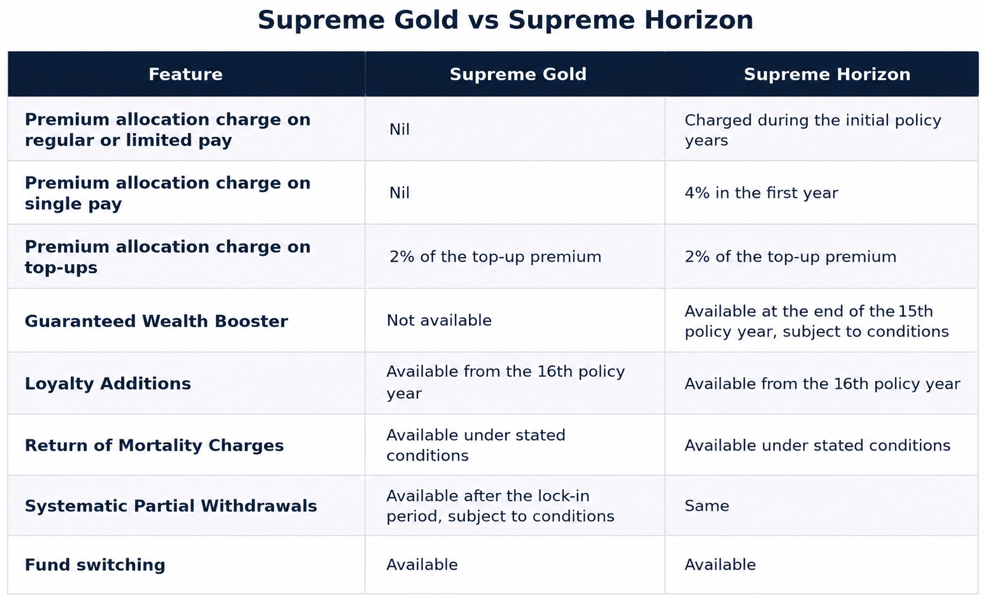
Supreme Gold Variant - The Gold variant has no premium allocation charge for regular pay, limited pay or single pay. This means the policy does not deduct an allocation charge from these base premiums before investing them. However, a charge of 2% applies to top-up premiums.
Gold may be more straightforward for a customer who prefers not to have an upfront premium allocation charge on the base premium. It still provides the common Bajaj Life Supreme features, including market-linked investment, loyalty additions, return of mortality charges, fund switching and systematic partial withdrawals.
Supreme Horizon Variant - Horizon deducts a premium allocation charge during the initial policy years. For regular or limited pay with annual premium frequency, the charge is 12% in the first year, 4.5% in the second and third years, and 4% in the fourth and fifth years. For non-annual frequencies, it is 9% in the first year, 4.5% in the second and third years, and 3% in the fourth and fifth years. No premium allocation charge applies from the sixth year onwards. A 4% charge applies to single pay in the first year, while top-up premiums carry a 2% charge.
The distinguishing benefit under Horizon is the Guaranteed Wealth Booster. The premium allocation charges deducted during the policy term are accumulated at a guaranteed rate of 7% per annum, compounded annually, and added to the fund value at the end of the 15th policy year in the form of additional units.
However, this should not be misunderstood as a guaranteed 7% return on the entire investment. The 7% guaranteed accumulation applies only to the eligible premium allocation charges that were deducted. The remaining policy fund continues to be market-linked.
The Wealth Booster is not available if the policy is surrendered, discontinued or converted into a paid-up policy before the applicable benefit date. It also does not apply to premium allocation charges deducted from top-up premiums.
Therefore, the Horizon leaflet describes the variant as having an “effectively zero premium allocation charge,” but this does not mean that no charge is deducted initially. The charges are first deducted and are subsequently added back at the end of the 15th year with the specified compounding growth, provided the policy remains in force and the applicable conditions are met.
Key Advantages of Bajaj Life Supreme
Potential for Market-Linked Wealth Creation - The policyholder can invest in market-linked funds offered under the plan. The available options include equity funds, index funds, small-cap and mid-cap funds, asset-allocation funds, liquid funds and debt funds.
This gives the policyholder the opportunity to select funds according to the investment horizon and risk tolerance. However, returns are not assured, and the fund value will depend on market performance.
Life Insurance Protection - The plan provides life cover throughout the selected policy term, subject to the policy remaining in force and all applicable terms being fulfilled.
The cost of life insurance protection is deducted through mortality charges. These charges depend on factors such as the life assured’s age, gender, selected sum assured and the insurer’s underwriting policy.
Loyalty Additions From the 16th Policy Year - Under both Gold and Horizon, Loyalty Additions are credited at the end of every year beginning from the 16th policy year and continuing until the end of the policy term.
The Loyalty Addition is calculated as 0.25% of the average fund value of the previous three years, including the current policy year. The additional units are added to the fund in the same proportion in which the existing fund value is invested.
Loyalty Additions are not applicable to top-up premiums or the top-up fund value. They are also not available if the policy is surrendered, discontinued or converted into a paid-up policy.
Return of Mortality Charges - Both variants provide for the return of eligible mortality charges in the form of additional units. At the end of the 15th policy year, 100% of the eligible mortality charges deducted up to that point are added back to the fund. Thereafter, mortality charges deducted during the previous five policy years are returned at every fifth policy year before maturity. At maturity, the remaining eligible mortality charges that have not already been returned are added back.
The return does not include extra mortality charges, applicable GST, cess or other taxes charged on the mortality cost. It is also not available when the policy is surrendered, discontinued or converted to paid-up status.
Systematic Partial Withdrawals - After completion of the five-year lock-in period, the policyholder may use the systematic partial withdrawal facility, subject to the terms and conditions of the policy. This facility may help create a periodic secondary income from the accumulated fund value. However, every withdrawal reduces the remaining fund value and may affect the amount available for future goals, maturity or death benefits.
Fund-Switching Facility - The policy allows the policyholder to switch money between available funds. This may help in adjusting the portfolio according to changing financial goals, market conditions or risk appetite.
The leaflet describes fund switching as tax-free, but actual tax treatment will depend on the tax laws prevailing at the relevant time. Policyholders should obtain independent tax advice before relying on any tax benefit.
Flexible Policy and Premium Terms - The plan provides fixed policy-term options of 15, 20, 25, 30 and 40 years, along with a Whole Life option. Customers can choose regular pay, limited pay or single pay, subject to age and eligibility conditions.
This flexibility allows the premium commitment and policy duration to be aligned with goals such as retirement, education funding or long-term wealth transfer.
Maturity Benefit - If the life assured is alive on the maturity date, the available fund value is paid as the maturity benefit. The policyholder may receive the maturity benefit as a single lump-sum payment or choose the Settlement Option, under which the benefit can be received systematically for a maximum period of five years.
The maturity value is not predetermined because it depends on factors such as premiums invested, selected funds, market performance, applicable charges, additions credited, withdrawals and fund switches made during the policy term.
Death Benefit - If the life assured dies during the policy term while the policy is in force and all due premiums have been paid, the death benefit will be the highest of:
- The prevailing Sum Assured, including the top-up Sum Assured, where applicable.
- The Fund Value available on the date the insurer is informed of the death.
- The guaranteed minimum death benefit of 105% of the total eligible premiums paid up to the date of death, including applicable top-up premiums.
The policy terminates after the death claim becomes payable.
The term “total premiums paid” refers to the base premiums paid under the policy and excludes explicitly collected extra premiums and taxes.
Important Charges Under the Plan
Policy Administration Charge - For regular and limited-pay policies, the policy administration charge is 0.09% of the annualised premium during the first five policy years and 0.20% during the sixth to twentieth policy years. No policy administration charge applies from the 21st policy year onwards. For single-pay policies, the charge is 0.05% of the single premium during the applicable period and becomes nil from the 21st policy year onwards.
The charge is deducted monthly by cancelling units at the prevailing unit price. The leaflet states that the charge is currently capped at ₹500 per month, subject to limits permitted by IRDAI from time to time.
Fund Management Charge - The fund management charge depends on the selected fund and is adjusted in the NAV daily.
The charges mentioned in the leaflets range from 0.50% per annum for the Sustainable Equity Fund to 1.35% per annum for several equity, index and market-linked funds. Debt-oriented funds such as the Bond Fund, Individual Short Term Debt Fund and Debt Plus Fund carry a charge of 0.95% per annum.
Mortality Charge - Mortality charge is the cost of providing the life insurance cover. It depends on the life assured’s age, gender, chosen sum assured and underwriting outcome.
The charge is deducted every month by cancelling units from the policy fund. Although eligible mortality charges may later be returned under the Return of Mortality Charges feature, extra mortality charges and taxes are excluded from the return.
Miscellaneous Charge - A miscellaneous charge of ₹100 per transaction may apply to transactions specified in the policy terms. It is deducted by cancelling units from the fund. Applicable GST, cess and other taxes are charged separately on the relevant policy charges.
Important Points to Understand Before Buying
Bajaj Life Supreme is primarily designed for long-term financial planning. The five-year lock-in means the invested amount cannot be completely or partially withdrawn during the first five years.
The value of the policy is linked to the capital markets. Neither the name of the plan nor the name of any fund indicates or guarantees the quality of the investment, future performance or returns.
The 4% and 8% returns shown in the sample illustrations are only assumed rates used to explain how the policy may work. They are not minimum or maximum returns and are not guaranteed outcomes.
Features such as Loyalty Additions, Return of Mortality Charges and the Horizon Guaranteed Wealth Booster are linked to specific conditions. Surrendering, discontinuing or converting the policy into paid-up status may result in the loss of some of these additions.
Overall Understanding- Bajaj Life Supreme is a long-term ULIP that provides market-linked investment along with life insurance cover. Gold and Horizon share the same eligibility, life cover structure, policy terms, premium options, maturity benefit and death benefit.
The Gold variant offers a simpler allocation-charge structure because there is no premium allocation charge on regular, limited or single premiums.
The Horizon variant deducts allocation charges during the initial years but accumulates eligible deducted charges at 7% per annum and adds them back at the end of the 15th policy year through the Guaranteed Wealth Booster, subject to the policy remaining eligible.
The final choice between Gold and Horizon should therefore be based on whether the customer prefers no base premium allocation charge from the beginning or is comfortable with the Horizon charge-and-booster structure while remaining invested for at least 15 years.
Who Is Bajaj Life Supreme For?
Bajaj Life Supreme may be considered by people who want to build wealth over a long period while maintaining life insurance protection under the same policy.
It may be suitable for individuals planning for long-term financial goals such as a child’s higher education, home purchase, retirement planning, wealth creation or legacy planning. Its policy terms extend from 15 years to whole life, making it more relevant for people who can remain invested for a long duration.
The plan may also be useful for individuals who want the flexibility to choose from equity, debt, index, asset-allocation and other market-linked funds based on their investment preferences and risk appetite.
However, this plan may not be suitable for someone who needs guaranteed investment returns, short-term liquidity or easy access to the invested money during the first five years. It is also important to understand that the life cover under a ULIP may not always be as high as the coverage available under a pure term insurance plan for the same premium.

5.0
Need advice from experts?
Too many plans, too much confusion? We'll simplify everything for you, completely FREE. 100% honest, 100% spam-free.

 Talk to an Advisor
 Talk to an Advisor