
Mediclaim Policy

Mediclaim Policy
A Mediclaim policy is a type of health insurance that helps you manage the cost of medical treatment and hospitalization. If you are hospitalized for a covered illness, injury, or treatment, the policy can pay for eligible expenses such as room charges, doctor’s fees, medicines, diagnostic tests, and other hospital-related costs, up to the available sum insured.
Like other health insurance plans, a Mediclaim policy is usually purchased for a fixed policy period. You need to renew it on time if you want to continue your health insurance coverage. In return, you pay a premium to keep the policy active and can use the coverage when you need eligible medical treatment.
With hospital and treatment costs going up, having suitable health insurance can make a big difference when an unexpected medical expense comes along. However, every Mediclaim policy is different. The coverage, waiting periods, exclusions, claim rules, and other benefits depend on the plan you choose.
So, before buying a Mediclaim policy, take a little time to understand what is covered, what is not covered, and what conditions apply to your policy. This can help you choose coverage that actually fits your needs instead of simply choosing a plan based on its premium.
What is Mediclaim Policy?
A Mediclaim policy is a type of health insurance that provides financial protection against eligible medical and hospitalization expenses, subject to the policy’s terms, conditions, exclusions, waiting periods, and coverage limits. The term “Mediclaim” has been widely used in India for decades and is still commonly used when referring to health insurance.
The original Mediclaim Policy was introduced in India in 1986 by the General Insurance Corporation of India (GIC) and its four subsidiary companies. It was primarily designed to provide reimbursement for eligible hospitalization expenses. Over the years, health insurance products in India have evolved significantly, with policies now offering features such as cashless hospitalization, day-care treatment, pre- and post-hospitalization coverage, and other benefits, depending on the plan.
What Does a Mediclaim Policy Cover?
A Mediclaim policy can help protect you from the financial burden of eligible medical and hospitalization expenses. Depending on the policy, benefits may include cashless treatment at network hospitals, coverage for hospitalization-related expenses, and tax benefits on eligible premiums. A Mediclaim policy can also provide financial support during unexpected illnesses, injuries, or medical emergencies, subject to the policy terms and applicable conditions.
Here are some of the key benefits of a Mediclaim policy:
A Mediclaim policy can help protect you from the financial burden of eligible medical and hospitalization expenses. Depending on the policy, benefits may include cashless treatment at network hospitals, coverage for hospitalization-related expenses, and tax benefits on eligible premiums. A Mediclaim policy can also provide financial support during unexpected illnesses, injuries, or medical emergencies, subject to the policy terms and applicable conditions.
Here are some of the key benefits of a Mediclaim policy:
1. Cashless Treatment at Network Hospitals Many Mediclaim and health insurance policies offer cashless hospitalization at network hospitals. Under this facility, the insurer or its authorised TPA settles eligible hospitalisation expenses directly with the hospital, subject to policy coverage and approval. You may still need to pay expenses that are not covered by the policy, along with applicable deductibles, co-payments, or other charges.
2. Financial Protection Against Medical Expenses A Mediclaim policy can reduce the financial impact of unexpected hospitalization and treatment costs. Depending on the coverage, eligible expenses such as hospitalisation, room charges, ICU charges, doctor’s fees, medicines, and diagnostic tests may be covered up to the applicable limits and sum insured.
3. Support During Medical Emergencies Medical emergencies can result in significant and unexpected expenses. Having an active Mediclaim policy can provide financial support for eligible treatment costs, allowing you to focus on receiving necessary medical care rather than managing the entire hospital bill from your savings.
4. Coverage for Eligible Hospitalization Expenses Depending on the plan, Mediclaim coverage may include expenses related to hospitalisation, such as room rent, ICU charges, doctor and surgeon fees, medicines, diagnostic tests, and other eligible treatment expenses. Pre-hospitalization, post-hospitalization, and day-care treatment may also be covered under certain policies.
5. Tax Benefits on Eligible Premiums Premiums paid for eligible health insurance policies may qualify for deductions under Section 80D of the Income Tax Act, subject to applicable tax laws, limits, and eligibility conditions. Tax benefits can vary depending on factors such as the insured person's age, who is covered, and the applicable tax regime.
6. Continued Protection Through Policy Renewal Health insurance policies are generally issued for a specific policy period and need to be renewed to continue coverage. Timely renewal can help maintain continuity of protection, subject to the insurer's terms, renewal conditions, and applicable regulations.
7. Access to a Network of Hospitals Insurers generally maintain a network of hospitals where eligible policyholders may be able to access cashless treatment. Before choosing a policy, it is important to check whether hospitals convenient for you are included in the insurer's current network.
Types of Mediclaim Policy Available in India
Several types of Mediclaim plans are available depending on individual needs. Individual Mediclaim covers only the policyholder. Family floater plans cover all family members under a shared sum insured. Group Mediclaim is offered by employers to employees. Senior citizen Mediclaim is designed for older adults with age-specific benefits. Critical illness Mediclaim covers major illnesses like cancer and kidney failure. Overseas Mediclaim provides coverage for medical treatments outside India. Low-cost Mediclaim policies are designed for economically weaker sections or small business employees requiring basic protection.
Understanding the types of Mediclaim policy is important before choosing the right plan for yourself or your family. Different people have different healthcare needs, and each type of Mediclaim insurance offers specific benefits. Here are the most common types:
- Individual Mediclaim Policy - This type of mediclaim covers only one person. It is ideal for individuals who want personal coverage with customized benefits.
- Family Floater Mediclaim Policy - In this type of policy, a single sum insured is shared among all family members. It is a cost-effective option for families and you will get attractive discount benefit by opting by opting family floater plan.
- Senior Citizen Mediclaim Policy – This policy is designed for people above 60 years, this category covers age-related illnesses and medical conditions.
- Critical Illness Mediclaim Insurance - These types of Mediclaim plans provide a lump-sum payout when diagnosed with serious illnesses like cancer, stroke, or heart disease.
- Maternity Mediclaim Policy – A maternity mediclaim policy provides financial protection for expenses related to pregnancy, childbirth, and newborn care. It covers costs like delivery, pre- and post-natal checkups, hospitalization, helping ease the financial burden during maternity.
Each type of mediclaim policy is designed to meet different healthcare needs. Some plans focus on basic hospitalization, while others offer wider benefits like maternity or critical illness support. The best mediclaim policy for you depends on factors such as age, family size, medical history, and budget. Choosing wisely ensures better financial protection during medical emergencies.
Inclusions Under Mediclaim Policy
Mediclaim policies usually cover expenses related to hospitalization for more than 24 hours. Many insurers also offer a cumulative bonus for every year in which no claim is made:
- Hospitalization Expenses - A Mediclaim insurance plan covers medical costs when you are admitted to the hospital for more than 24 hours. This includes doctor fees, surgery charges, nursing care, and all treatment related expenses.
- Room Rent Expenses - Your health medical insurance policy includes coverage for hospital room rent whether it is a single private room, shared room or deluxe room depending on the plan. Choosing the best Mediclaim policy helps you get higher room rent limits or even no room rent capping.
- Consumable Expenses - Modern medical treatments includes one time usable things like gloves, syringes, PPE kits, masks, bandages, and etc.
Exclusions Under Mediclaim Policy
A Mediclaim policy does not cover every medical expense. Certain treatments, conditions, procedures, or expenses may be excluded or restricted according to the policy terms. Common exclusions can include specific cosmetic procedures, certain treatments during waiting periods, non-medical expenses, and treatments that are specifically excluded by the insurer.
Before purchasing a Mediclaim policy, carefully review the policy wording to understand exclusions, waiting periods, sub-limits, deductibles, co-payments, and other conditions that may affect your claim.
Some common exclusions under Mediclaim policies may include:
1. Cosmetic or Plastic Surgery Cosmetic or plastic surgery performed primarily for beautification or aesthetic purposes is generally not covered unless it is medically necessary or covered under the specific policy. Reconstructive surgery following an accident or certain medical conditions may be covered depending on the policy terms.
2. Pre-Existing Diseases During the Waiting Period Pre-existing diseases may be subject to a specific waiting period. Treatment related to such conditions may not be covered until the applicable waiting period has been completed, subject to the policy terms.
3. Pregnancy and Maternity Expenses Pregnancy, childbirth, and related expenses may be excluded or subject to a maternity waiting period unless the policy specifically provides maternity coverage. Always check the maternity benefits and applicable conditions before purchasing a policy.
4. Certain Dental Treatments Routine dental treatment may not be covered under many Mediclaim policies. However, dental treatment required because of an accident or covered under specific policy benefits may be eligible, subject to the applicable terms and limits.
5. Self-Inflicted Injuries Expenses arising from intentional self-inflicted injuries or certain suicide attempts may be excluded or restricted, depending on the policy terms and applicable conditions.
6. Treatment Related to Alcohol or Substance Abuse Treatment or injuries arising from alcohol or substance use may be excluded or restricted under certain policies. The exact exclusion depends on the insurer's policy wording.
7. Diagnostic Tests Without Medical Necessity Routine health checks, diagnostic tests performed without a medical indication, or tests that are not otherwise covered by the policy may not be payable. Coverage depends on the reason for the test and the policy terms.
8. Experimental or Unproven Treatments Treatments, procedures, or therapies that are not recognized or are considered experimental, investigational, or unproven may be excluded unless specifically covered by the policy.
9. War, Nuclear Events, Riots, or Hazardous Activities Some policies may exclude or restrict claims arising from war, nuclear risks, civil unrest, riots, or participation in certain hazardous or adventure activities. The exact exclusions vary by policy and insurer.
10. Other Policy-Specific Exclusions A Mediclaim policy may contain additional exclusions based on the insurer, product, medical condition, treatment, or coverage selected. These may include specific procedures, non-medical expenses, treatment outside the scope of coverage, or expenses exceeding applicable limits.
Exclusions are not identical across all Mediclaim or health insurance policies. Always read the policy wording and schedule carefully to understand what is covered, what is excluded, and which waiting periods, limits, deductibles, or co-payments apply.
How to File a Health Insurance Claim?
1. Cashless Claim Process - The easiest and fastest way to get treatment in the insurer’s network hospitals. So here is the step:
- Get admitted to a network hospital.
- Show your policy card or policy number to the hospital TPA
- Fill the pre-authorization form.
- Hospital sends the request to insurer/TPA.
- Once approved, treatment begins.
- Insurer settles the bill directly with the hospital.
2. Reimbursement Claim Process - In this claim process you have to pay expenses from your own pocket, and after that you can claim it through your insurer by submiting below mentioned documents:
- Pay the hospital bill at the time of discharge.
- Collect all original medical documents.
- Submit a reimbursement claim form to the insurer.
- Insurer verifies documents.
- Approved amount is transferred to your bank account.
Waiting Periods in Mediclaim Policy
Waiting period refers to the duration during which certain benefits cannot be claimed. Here are some types of waiting periods:
- Initial Waiting Period - No claim is allowed for the first 30 days of policy purchase and after this period seasonable disease are covered.
- Specific Illness Waiting Period- Conditions like hernia, piles, joint replacement, cataract are covered after 2 years of waiting period.
- Pre-Existing Disease Waiting Period - Diseases like diabetes, BP, thyroid, asthma, which is policyholder have before buying the policy are covered after 3 years of waiting period.
- Maternity Waiting Period - Applicable if the plan offers maternity benefits, and in most plan maternity have 1 to 2 years waiting period.

5.0
Need advice from experts?
Don't guess your health cover, get expert guidance in one quick call.
What is Mediclaim Policy?
A Mediclaim policy is a type of health insurance that provides financial protection against eligible medical and hospitalization expenses, subject to the policy’s terms, conditions, exclusions, waiting periods, and coverage limits. The term “Mediclaim” has been widely used in India for decades and is still commonly used when referring to health insurance.
The original Mediclaim Policy was introduced in India in 1986 by the General Insurance Corporation of India (GIC) and its four subsidiary companies. It was primarily designed to provide reimbursement for eligible hospitalization expenses. Over the years, health insurance products in India have evolved significantly, with policies now offering features such as cashless hospitalization, day-care treatment, pre- and post-hospitalization coverage, and other benefits, depending on the plan.
How Does a Mediclaim Policy Work?
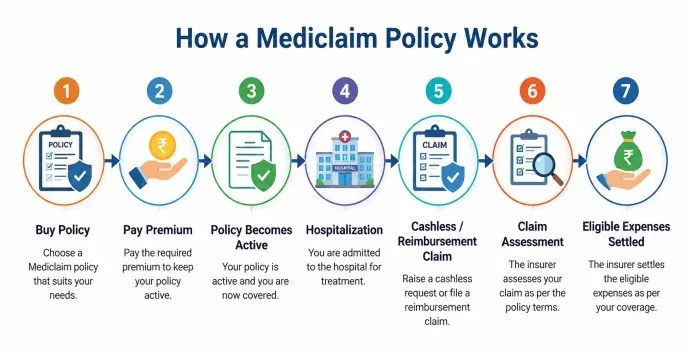
A Mediclaim policy provides financial support for eligible medical and hospitalisation expenses. After paying the premium, you can use cashless treatment at network hospitals or claim reimbursement. The insurer settles eligible expenses based on the policy terms, including the sum insured, exclusions, waiting periods, deductibles, and applicable limits.
What Does a Mediclaim Policy Cover?
A Mediclaim policy can help protect you from the financial burden of eligible medical and hospitalization expenses. Depending on the policy, benefits may include cashless treatment at network hospitals, coverage for hospitalization-related expenses, and tax benefits on eligible premiums. A Mediclaim policy can also provide financial support during unexpected illnesses, injuries, or medical emergencies, subject to the policy terms and applicable conditions.
Here are some of the key benefits of a Mediclaim policy:
1. Cashless Treatment at Network Hospitals Many Mediclaim and health insurance policies offer cashless hospitalization at network hospitals. Under this facility, the insurer or its authorised TPA settles eligible hospitalisation expenses directly with the hospital, subject to policy coverage and approval. You may still need to pay expenses that are not covered by the policy, along with applicable deductibles, co-payments, or other charges.
2. Financial Protection Against Medical Expenses A Mediclaim policy can reduce the financial impact of unexpected hospitalization and treatment costs. Depending on the coverage, eligible expenses such as hospitalisation, room charges, ICU charges, doctor’s fees, medicines, and diagnostic tests may be covered up to the applicable limits and sum insured.
3. Support During Medical Emergencies Medical emergencies can result in significant and unexpected expenses. Having an active Mediclaim policy can provide financial support for eligible treatment costs, allowing you to focus on receiving necessary medical care rather than managing the entire hospital bill from your savings.
4. Coverage for Eligible Hospitalization Expenses Depending on the plan, Mediclaim coverage may include expenses related to hospitalisation, such as room rent, ICU charges, doctor and surgeon fees, medicines, diagnostic tests, and other eligible treatment expenses. Pre-hospitalization, post-hospitalization, and day-care treatment may also be covered under certain policies.
5. Tax Benefits on Eligible Premiums Premiums paid for eligible health insurance policies may qualify for deductions under Section 80D of the Income Tax Act, subject to applicable tax laws, limits, and eligibility conditions. Tax benefits can vary depending on factors such as the insured person's age, who is covered, and the applicable tax regime.
6. Continued Protection Through Policy Renewal Health insurance policies are generally issued for a specific policy period and need to be renewed to continue coverage. Timely renewal can help maintain continuity of protection, subject to the insurer's terms, renewal conditions, and applicable regulations.
7. Access to a Network of Hospitals Insurers generally maintain a network of hospitals where eligible policyholders may be able to access cashless treatment. Before choosing a policy, it is important to check whether hospitals convenient for you are included in the insurer's current network.
Types of Mediclaim Policy Available in India
Several types of Mediclaim plans are available depending on individual needs. Individual Mediclaim covers only the policyholder. Family floater plans cover all family members under a shared sum insured. Group Mediclaim is offered by employers to employees. Senior citizen Mediclaim is designed for older adults with age-specific benefits. Critical illness Mediclaim covers major illnesses like cancer and kidney failure. Understanding the types of Mediclaim policy is important before choosing the right plan for yourself or your family. Different people have different healthcare needs, and each type of Mediclaim insurance offers specific benefits. Here are the most common types:
- Individual Mediclaim Policy - This type of mediclaim covers only one person. It is ideal for individuals who want personal coverage with customized benefits.
- Family Floater Mediclaim Policy - In this type of policy, a single sum insured is shared among all family members. It is a cost-effective option for families and you will get attractive discount benefit by opting by opting family floater plan.
- Senior Citizen Mediclaim Policy – This policy is designed for people above 60 years, this category covers age-related illnesses and medical conditions.
- Critical Illness Mediclaim Insurance - These types of Mediclaim plans provide a lump-sum payout when diagnosed with serious illnesses like cancer, stroke, or heart disease.
- Maternity Mediclaim Policy – A maternity mediclaim policy provides financial protection for expenses related to pregnancy, childbirth, and newborn care. It covers costs like delivery, pre- and post-natal checkups, hospitalization, helping ease the financial burden during maternity.
Each type of mediclaim policy is designed to meet different healthcare needs. Some plans focus on basic hospitalization, while others offer wider benefits like maternity or critical illness support. The best mediclaim policy for you depends on factors such as age, family size, medical history, and budget. Choosing wisely ensures better financial protection during medical emergencies.
Inclusions Under Mediclaim Policy
Mediclaim policies usually cover expenses related to hospitalization for more than 24 hours. Many insurers also offer a cumulative bonus for every year in which no claim is made:
- Hospitalization Expenses - A Mediclaim insurance plan covers medical costs when you are admitted to the hospital for more than 24 hours. This includes doctor fees, surgery charges, nursing care, and all treatment related expenses.
- Room Rent Expenses - Your health medical insurance policy includes coverage for hospital room rent whether it is a single private room, shared room or deluxe room depending on the plan. Choosing the best Mediclaim policy helps you get higher room rent limits or even no room rent capping.
- Consumable Expenses - Modern medical treatments includes one time usable things like gloves, syringes, PPE kits, masks, bandages, and etc.
Exclusions Under Mediclaim Policy
A Mediclaim policy does not cover every medical expense. Certain treatments, conditions, procedures, or expenses may be excluded or restricted according to the policy terms. Common exclusions can include specific cosmetic procedures, certain treatments during waiting periods, non-medical expenses, and treatments that are specifically excluded by the insurer.
Before purchasing a Mediclaim policy, carefully review the policy wording to understand exclusions, waiting periods, sub-limits, deductibles, co-payments, and other conditions that may affect your claim.
Some common exclusions under Mediclaim policies may include:
1. Cosmetic or Plastic Surgery Cosmetic or plastic surgery performed primarily for beautification or aesthetic purposes is generally not covered unless it is medically necessary or covered under the specific policy. Reconstructive surgery following an accident or certain medical conditions may be covered depending on the policy terms.
2. Pre-Existing Diseases During the Waiting Period Pre-existing diseases may be subject to a specific waiting period. Treatment related to such conditions may not be covered until the applicable waiting period has been completed, subject to the policy terms.
3. Pregnancy and Maternity Expenses Pregnancy, childbirth, and related expenses may be excluded or subject to a maternity waiting period unless the policy specifically provides maternity coverage. Always check the maternity benefits and applicable conditions before purchasing a policy.
4. Certain Dental Treatments Routine dental treatment may not be covered under many Mediclaim policies. However, dental treatment required because of an accident or covered under specific policy benefits may be eligible, subject to the applicable terms and limits.
5. Self-Inflicted Injuries Expenses arising from intentional self-inflicted injuries or certain suicide attempts may be excluded or restricted, depending on the policy terms and applicable conditions.
6. Treatment Related to Alcohol or Substance Abuse Treatment or injuries arising from alcohol or substance use may be excluded or restricted under certain policies. The exact exclusion depends on the insurer's policy wording.
7. Diagnostic Tests Without Medical Necessity Routine health checks, diagnostic tests performed without a medical indication, or tests that are not otherwise covered by the policy may not be payable. Coverage depends on the reason for the test and the policy terms.
8. Experimental or Unproven Treatments Treatments, procedures, or therapies that are not recognized or are considered experimental, investigational, or unproven may be excluded unless specifically covered by the policy.
9. War, Nuclear Events, Riots, or Hazardous Activities Some policies may exclude or restrict claims arising from war, nuclear risks, civil unrest, riots, or participation in certain hazardous or adventure activities. The exact exclusions vary by policy and insurer.
10. Other Policy-Specific Exclusions A Mediclaim policy may contain additional exclusions based on the insurer, product, medical condition, treatment, or coverage selected. These may include specific procedures, non-medical expenses, treatment outside the scope of coverage, or expenses exceeding applicable limits.
Exclusions are not identical across all Mediclaim or health insurance policies. Always read the policy wording and schedule carefully to understand what is covered, what is excluded, and which waiting periods, limits, deductibles, or co-payments apply.
Is Mediclaim the Same as Health Insurance?
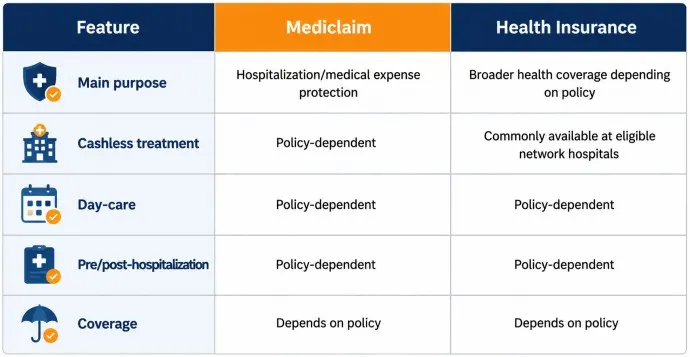
Mediclaim and health insurance are not exactly the same, although people in India often use these words interchangeably. Mediclaim generally refers to cover for medical and hospitalisation expenses, while health insurance is a wider term that can include different types of health-related coverage.
The confusion is understandable because today's health insurance plans can offer many of the features people associate with Mediclaim, such as cashless hospitalisation, day-care treatment and pre- and post-hospitalisation cover. So, when you are choosing a plan, don't focus too much on the name. Take a look at the actual coverage and see whether it matches your needs.
How to File a Health Insurance Claim?
1. Cashless Claim Process - The easiest and fastest way to get treatment in the insurer’s network hospitals. So here is the step:
- Get admitted to a network hospital.
- Show your policy card or policy number to the hospital TPA
- Fill the pre-authorization form.
- Hospital sends the request to insurer/TPA.
- Once approved, treatment begins.
- Insurer settles the bill directly with the hospital.
2. Reimbursement Claim Process - In this claim process you have to pay expenses from your own pocket, and after that you can claim it through your insurer by submiting below mentioned documents:
- Pay the hospital bill at the time of discharge.
- Collect all original medical documents.
- Submit a reimbursement claim form to the insurer.
- Insurer verifies documents.
- Approved amount is transferred to your bank account.
Waiting Periods in Mediclaim Policy
Waiting period refers to the duration during which certain benefits cannot be claimed. Here are some types of waiting periods:
- Initial Waiting Period - No claim is allowed for the first 30 days of policy purchase and after this period seasonable disease are covered.
- Specific Illness Waiting Period- Conditions like hernia, piles, joint replacement, cataract are covered after 2 years of waiting period.
- Pre-Existing Disease Waiting Period - Diseases like diabetes, BP, thyroid, asthma, which is policyholder have before buying the policy are covered after 3 years of waiting period.
- Maternity Waiting Period - Applicable if the plan offers maternity benefits, and in most plan maternity have 1 to 2 years waiting period.
How to Choose the Right Mediclaim Policy?
Buying a Mediclaim policy is not something you should decide just by looking at the premium. A plan may look affordable at first, but what really matters is how useful that policy will be when you or your family actually need medical treatment. Before choosing one, take some time to understand the coverage, limitations and costs involved. Here are a few things that can make the decision easier.
Check How Much Coverage You Need - Start with the sum insured. Think about who you are buying the policy for, your age, where you live and the kind of healthcare costs you may face. Someone buying insurance for themselves may have different needs from a family looking to cover several members under one policy.
There is no single coverage amount that works for everyone. The important thing is to choose an amount that gives you reasonable financial protection without making the premium difficult to manage.
Don't Pick a Policy Just Because It Is Cheap - Price is definitely important, but it shouldn't be the only thing you compare.
Two Mediclaim policies can have similar premiums and still be quite different when it comes to coverage, waiting periods, exclusions and claim-related conditions. A slightly cheaper policy may also have restrictions that you don't notice until you need to use it. So, look at what you're getting for the premium rather than simply choosing the lowest price.
See Which Hospitals Are Available - Nobody wants to search for a hospital at the last minute during an emergency. That's why it makes sense to check the insurer's network hospitals before buying the policy.
If hospitals near your home or workplace are included in the network, getting cashless treatment can be more convenient when you need eligible hospitalization.
Don't Ignore the Waiting Period - Waiting periods are easy to overlook when you're comparing plans, but they can become important later.
For example, if you already have a pre-existing disease, treatment related to that condition may not be covered immediately. Some treatments and benefits can also have their own waiting periods. Read this part carefully instead of assuming that your policy will cover everything from the first day.
Read the Benefits and Exclusions Together - Most people look at the list of benefits first. That's understandable, but the exclusions deserve just as much attention.
Check what the policy covers for hospitalization, day-care treatment, medicines, diagnostic tests and pre- and post-hospitalization expenses. Then look at what is not covered and whether there are any limits attached to particular treatments. This gives you a much clearer picture of what the policy actually offers.
Look for Hidden Out-of-Pocket Costs - A policy can cover hospitalization and still leave you with some expenses to pay.
For example, there could be a co-payment, deductible, room-rent limit or treatment-specific sub-limit. These conditions can affect the amount you eventually receive from the insurer. Understanding these details before buying can save you from an unexpected bill later.
Compare Before You Decide - Once you have shortlisted a few options, compare them properly. Look at the sum insured, premium, coverage, waiting periods, exclusions, network hospitals, co-payment, deductibles and claim process.
The right Mediclaim policy isn't necessarily the one with the lowest premium or the highest number of benefits. It is the one that makes sense for your situation and gives you coverage you can actually rely on when you need medical care.
A Simple Checklist Before Buying Mediclaim Policy
Before you finally choose a Mediclaim policy, ask yourself:
- Is the sum insured enough for my needs?
- Are the hospitals I would prefer included in the network?
- How long are the waiting periods?
- What important treatments or expenses are excluded?
- Are there any room-rent limits or sub-limits?
- Will I have to pay a co-payment or deductible?
- Do I understand how the claim process works?
Can I comfortably continue paying the premium in the coming years?
Taking a little time to go through these points can help you make a more informed choice and avoid surprises when you actually need to use your health insurance.
What Should You Check Before Buying a Mediclaim Policy?
Don't look at the premium alone. Check the waiting periods along with the coverage, exclusions, sum insured, room-rent limits and other conditions.
If you have a pre-existing disease or are specifically looking for maternity coverage, pay extra attention to the relevant waiting period. Knowing these details beforehand can save you from an unpleasant surprise when you actually need to use your insurance.
In simple terms, the waiting period is the time you need to complete before certain parts of your Mediclaim coverage become available. The exact waiting period depends on the policy, so always check the policy wording before making a decision.
How Does Cashless Mediclaim Work?
Suppose you need to be admitted to a hospital for a planned treatment. You visit a hospital that is part of your insurer's network and provide your policy details. The hospital then starts the cashless request with the insurer or TPA.
After reviewing the request and the policy coverage, the insurer gives the required approval if the treatment is eligible. The hospital can then proceed with the treatment under the cashless arrangement.
At the time of discharge, the insurer settles the approved amount directly with the hospital. You pay whatever part of the bill is not covered under your policy.
Cashless vs Reimbursement Claim
The main difference is how the hospital bill is paid. With a cashless claim, the insurer settles the approved amount directly with a network hospital. With a reimbursement claim, you generally pay the hospital first and later submit the required documents to the insurer for reimbursement of eligible expenses. Both methods can provide coverage, but the process is different.
Simply Cashless Mediclaim makes hospitalization easier on your pocket because you don't have to arrange the full eligible hospital bill upfront. However, you should still keep some money available for expenses that your policy does not cover.

5.0
Need advice from experts?
Too many plans, too much confusion? We'll simplify everything for you, completely FREE. 100% honest, 100% spam-free.

 Talk to an Advisor
 Talk to an Advisor