
Health Insurance vs Life Insurance
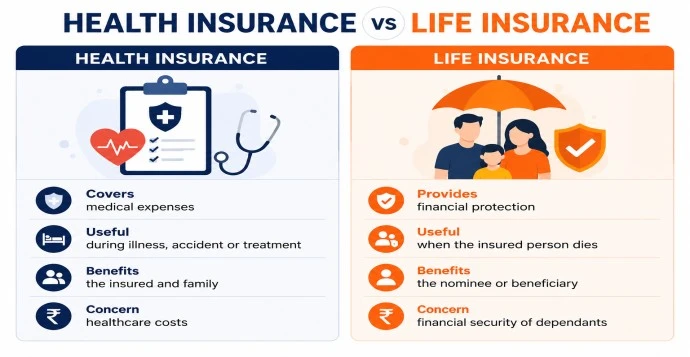
Health Insurance vs Life Insurance
Health Insurance and Life Insurance are meant for two different situations. Health insurance helps pay for covered medical treatment and hospitalisation, while life insurance gives financial support to the nominee if the insured person dies during the policy term. So, health insurance is mainly about handling medical expenses, whereas life insurance is about protecting your family's finances after your death.
If you're wondering which one you should buy, don't look at them as two competing products. The better choice depends on your circumstances. Someone who lives alone and has no dependents may have different priorities from a parent who is paying a home loan and supporting a family.
Health Insurance vs Life Insurance
The table below gives a quick comparison of Health Insurance and Life Insurance, making it easier to understand how their coverage and purpose differ.
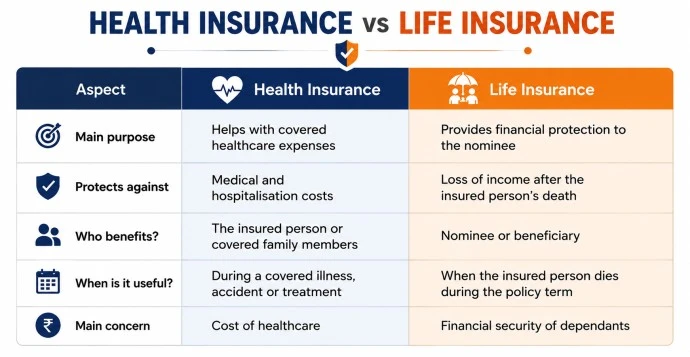
The terms of an actual policy can be quite different from another. Coverage limits, exclusions, waiting periods, co-payments and other conditions should always be checked before buying.
What is the Difference Between Life and Health Insurance?
Health insurance deals mainly with covered medical expenses, while life insurance provides a financial benefit to the nominee after the insured person's death, subject to the policy terms.The easiest way to understand it is to imagine two different problems.
Suppose you need to undergo a covered surgery and the hospital bill is ₹3 lakh. The immediate concern is finding money for the treatment. That's where health insurance can help.
Now consider a different situation. You are the primary earner in your family and you die unexpectedly. Your family may have to continue paying the home loan, school fees and everyday expenses without your income. Life insurance is intended to provide financial support to the nominee in such a situation.
So the two policies are solving different problems. Health insurance is primarily about the cost of getting treatment. Life insurance is primarily about the financial consequences of losing an earning member. Having one doesn't give you the protection provided by the other.
Which is Better, Health Insurance or Life Insurance?
Neither is automatically better. They protect you from different financial risks. If you're worried about a large hospital bill eating into your savings, health insurance addresses that concern.
If your spouse, children or parents depend on your income, life insurance addresses a different concern: how your family would manage financially if you were no longer earning. Consider two people. The first is 24, lives with their parents, has no loans and doesn't have anyone financially dependent on them. Their immediate need may be adequate health coverage.
The second is 38, has a spouse, two children and a home loan. Medical expenses are still a concern, but there is another risk that can't be ignored—the family's loss of income if that person dies. For the second person, both types of insurance could have a meaningful role.
So asking which one is “better” isn't really the right question. A better question is which financial problem would be harder for you or your family to handle?
Should You Buy Life Insurance or Health Insurance?
If you can afford only one for now, consider your biggest financial vulnerability. Health insurance can protect your savings against covered medical expenses, while life insurance is particularly important when other people depend on your income. If possible, consider having both because they serve different purposes.
Your situation matters more than a general rule.
Can You Take Both Health Insurance and Life Insurance Together?
Yes, you can have health insurance and life insurance at the same time, and there is no need for one policy to replace the other. In fact, having both can make sense because they cover different financial risks. Health insurance can help with eligible hospitalisation and treatment expenses, while life insurance provides a benefit to your nominee if you die during the policy term. For example, if you have a family, health insurance can help when someone needs medical treatment, while life insurance can support the family financially if the primary earner dies. The coverage, exclusions and claim conditions are different for each policy, so both should be evaluated separately.
What are the Tax Benefits Under Section 80D and Section 80C?
Health insurance premiums may qualify for a deduction under Section 80D of the Income Tax Act, while eligible life insurance premiums may qualify under Section 80C, subject to the applicable tax rules and limits. Section 80D is specifically associated with health insurance premiums and certain other qualifying medical expenses. Section 80C covers several eligible investments and payments, including qualifying life insurance premiums, within the overall deduction limit applicable under the relevant tax regime. Importantly, tax deductions depend on factors such as the policy, taxpayer, payment method and tax regime. The availability and limits of deductions can also change with tax laws, so check the current rules before making a decision based only on tax savings.
FAQs:
1. Do I Need Both Health Insurance and Life Insurance? For many people, having both can be useful because they protect against different financial risks. Health insurance helps with eligible medical and hospitalisation expenses, while life insurance provides financial support to the nominee if the insured person dies during the policy term. If you have a family that depends on your income, life insurance can be particularly important. At the same time, health insurance can prevent a major medical expense from eating into your savings. Your age, income, dependants, debts and financial goals should determine the type and amount of cover you choose.
2. Is Health Insurance Enough If I Already Have Life Insurance? No. Life insurance does not replace health insurance. A life insurance policy is primarily designed to provide a benefit to your nominee after your death. It generally isn't meant to pay your regular hospital bills. Health insurance, on the other hand, is designed to help cover eligible medical expenses according to the policy terms. So, if you have life insurance but no health cover, you could still have to arrange a large amount of money yourself if you need expensive medical treatment.
3. Does Life Insurance Cover Medical Expenses? Generally, life insurance and health insurance cover different needs, so you shouldn't expect a standard life insurance policy to pay your regular medical expenses. Life insurance is mainly focused on providing financial protection to the nominee after the insured person's death. Some life insurance products may offer additional riders or benefits related to particular conditions, but these depend on the specific policy. If your main concern is protection against hospitalisation and treatment costs, you should look at suitable health insurance rather than relying on life insurance for medical coverage.
4. How Much Health Insurance and Life Insurance Should I Have? There is no single amount that works for everyone. For health insurance, consider your family's healthcare needs, medical costs in your city, number of people covered and the level of savings you have. For life insurance, look at your income, outstanding loans, dependants, children's future expenses and existing assets. A person with no financial dependants will usually have different life insurance needs from someone supporting a spouse, children and parents. Instead of choosing a cover amount just because it is popular, calculate what your family would realistically need.
5. Can I Buy Health Insurance and Life Insurance Separately? Yes, health insurance and life insurance can generally be purchased as separate policies. This can actually make it easier to choose coverage based on your individual needs. You can select a health insurance plan that suits your medical and family requirements and a life insurance policy that reflects your financial responsibilities. The two policies will have separate premiums, coverage conditions, exclusions and claim processes. Keeping these purposes separate also makes it easier to understand what protection you actually have instead of assuming that one insurance policy covers every type of financial risk.

5.0
Need advice from experts?
Health is tricky, and insurance trickier. But we'll simplify it for you — for FREE! Book a call now. Limited slots available!
 Talk to an Advisor

 Talk to an Advisor