
Health Insurance Benefits in Income Tax
Health Insurance Benefits in Income Tax
Is Health Insurance Premium Tax Deductible?
Yes. Health insurance premiums can qualify for an income-tax deduction under Section 80D, but the benefit depends on the tax regime you choose.
Under the old tax regime, an individual can generally claim a deduction for eligible health insurance premiums paid for self, spouse, dependent children and parents. The limit is up to ₹25,000 for self/family and another ₹25,000 for parents, with the limit increasing to ₹50,000 for a senior-citizen category. Therefore, the maximum deduction can reach ₹1 lakh in certain situations.
Section 80D is not available under the new tax regime. The Income Tax Department's current AY 2026–27 guidance confirms that 80D deductions are available when the old tax regime is selected.
So, health insurance is not only about protecting yourself from rising medical costs. For eligible taxpayers under the old regime, it can also provide a tax-saving benefit.
What You Should Know
Buying a health insurance policy is usually seen as a way to protect your savings from unexpected hospital bills. But there's another benefit many people overlook.
The premium you pay for eligible health insurance can also help reduce your taxable income under Section 80D if you are using the old tax regime.
That makes health insurance useful from two angles:
Financial protection + potential tax benefit However, there are limits, conditions and rules you should understand before assuming that your entire premium will be tax-deductible.
Let's break it down in simple terms.
What Is Section 80D for Health Insurance?
Section 80D of the Income-tax Act provides a deduction for eligible payments towards health insurance premiums, preventive health check-ups and certain medical expenses for senior citizens.
An individual can claim eligible deductions for policies covering:
- Self
- Spouse
- Dependent children
- Parents
The Income Tax Department currently lists the applicable 80D limits for AY 2026–27.
In simple words, if you pay an eligible health insurance premium for yourself or your family, you may be able to deduct the eligible amount from your taxable income under the old regime.
How Much Health Insurance Premium Is Tax Deductible?
This is probably the first question most people have.
The answer depends mainly on who is covered and whether the relevant insured person is a senior citizen.
Section 80D Deduction Limits
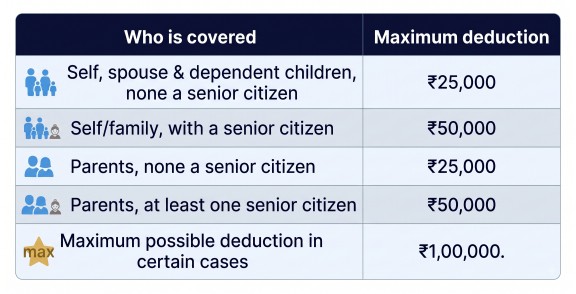
The ₹5,000 preventive health check-up limit is included within the applicable overall 80D limit; it is not an additional ₹5,000 on top of it.
Example Suppose you are below 60 and pay:
- ₹20,000 premium for your family
- ₹45,000 premium for your senior-citizen parents
Your eligible deduction could be up to:
₹20,000 + ₹45,000 = ₹65,000, subject to the applicable Section 80D conditions and limits.
This is one of the useful Health Insurance Benefits that people should consider while planning their finances.
Can You Claim a Tax Deduction for Parents' Health Insurance?
Yes. Eligible health insurance premiums paid for parents can qualify separately under Section 80D. This is particularly useful when you purchase health insurance for ageing parents.
If neither parent is a senior citizen, the applicable limit for parents is generally ₹25,000.
If at least one parent qualifies as a senior citizen, the limit can increase to ₹50,000.
For example: Self & family: Up to ₹25,000
Senior-citizen parents: Up to ₹50,000
Potential total: ₹75,000
If the self/family category also qualifies for the ₹50,000 senior-citizen limit, the overall deduction can reach ₹1 lakh.
What Is the Senior Citizen Limit Under Section 80D?
For Section 80D purposes, a senior citizen is generally a resident individual aged 60 years or more during the relevant previous year. The higher ₹50,000 limit can apply when the relevant insured person falls into the senior-citizen category.
The higher ₹50,000 limit can apply when the relevant insured person falls into the senior-citizen category. This is especially important for families buying health insurance for parents because the tax deduction limit can be higher than the standard ₹25,000 limit.
Can Senior Citizens Claim a Deduction for Medical Expenses?
Yes, in certain circumstances.
If a senior citizen is not covered by a health insurance policy and no premium is paid to keep health insurance coverage in force for that person, Section 80D can allow a deduction for eligible medical expenditure, subject to the applicable limit and conditions. The Income Tax Department currently lists a ₹50,000 deduction limit for eligible medical expenditure for a senior citizen in such circumstances.
This provision can be particularly relevant for senior citizens who may find it difficult to obtain or maintain suitable insurance coverage.
Is Preventive Health Check-Up Covered Under Section 80D?
Yes. Preventive health check-up expenses can qualify for a deduction of up to ₹5,000, but this amount is included within the overall Section 80D limit.
For example, if your applicable Section 80D limit is ₹25,000 and you spend ₹5,000 on a preventive health check-up, you cannot claim ₹25,000 for the insurance premium plus another ₹5,000 separately. The maximum remains ₹25,000 for that category.
One useful difference is that payment for a preventive health check-up can be made in cash. Other eligible health insurance premium payments generally need to be made through a non-cash mode.
Is Section 80D Available Under the New Tax Regime?
No. Section 80D deduction is not available if you choose the new tax regime. This is one of the most important points to remember.
The current Income Tax Department guidance for AY 2026–27 shows Section 80D as an old-regime deduction, and the CBDT's ITR validation rules specify that 80D should not be claimed when the new tax regime is selected. So don't assume that buying health insurance automatically gives you a tax deduction.
The tax regime you choose matters.
Does Buying Health Insurance Give You a Tax Refund?
Not directly.
A Section 80D deduction reduces your taxable income; it does not mean the government refunds the entire health insurance premium.
For example, if you are eligible for a ₹25,000 deduction, your taxable income can be reduced by the eligible amount. The actual tax saving depends on your applicable tax rate and overall tax situation.
So it is better to think of Section 80D as a tax deduction, not a cash back benefits.
What Documents Do You Need to Claim the Deduction?
When filing your income-tax return, keep your health insurance documents and payment records safely.
The Income Tax Department's current guidance asks taxpayers claiming 80D to provide details such as:
- Name of the insurer
- Policy number
- Health insurance amount
It is also sensible to keep the premium receipt, policy document and payment proof in your records in case they are required later.
Can You Claim Tax Benefits for a Family Health Insurance Policy?
Yes, eligible premiums for a family health insurance policy can qualify under Section 80D, subject to the applicable limits and conditions.
This is one reason a family should look at health insurance as more than just an annual expense. A suitable family policy can help protect your savings from hospitalisation expenses, while the eligible premium may also provide a tax deduction under the old regime.
However, don't buy a policy only for the tax benefit. The primary purpose of health insurance should be adequate medical protection.
Tax savings should be considered an additional benefit.
What Are the Main Health Insurance Benefits Beyond Tax Saving?
Tax deduction is useful, but it is only one part of the picture. The more important benefit is financial protection against unexpected medical expenses.
Depending on the policy, health insurance may provide benefits such as:
- Hospitalisation coverage
- Pre- and post-hospitalisation expenses
- Daycare procedures
- Ambulance expenses
- Certain home healthcare treatments
- Organ donor expenses
- Restoration or recharge of sum insured
- Cashless treatment at eligible network hospitals
Coverage differs between insurers and plans, so always check the actual policy terms before buying.
This is where the real value of Health insurance benefits comes in. A policy should be selected based on the protection it provides-not simply because it offers a tax deduction.
Common Mistakes People Make About Health Insurance Tax Benefits
1. Assuming 80D works under both tax regimes It doesn't. Section 80D is currently an old-regime deduction.
2. Treating ₹5,000 preventive check-up benefit as extra The ₹5,000 limit is included within the applicable 80D limit.
3. Choosing health insurance only for tax saving Tax benefits shouldn't be the main reason for buying a policy.
4. Ignoring parents' eligibility Parents have a separate 80D limit, which can be particularly valuable when they are senior citizens.
5. Paying premiums in cash Eligible health insurance premium payments generally need to be made through a non-cash mode. Preventive health check-up payments are the exception.
6. Forgetting the policy documents Keep premium receipts and policy details properly organised for your tax records.
How Should You Choose Health Insurance for Tax and Protection?
If you're buying health insurance, don't start with: "How much tax will I save?"
Start with: "How much medical protection does my family actually need?"
Then compare: Coverage → Sum Insured → Waiting Period → Exclusions → Network Hospitals → Co-payment → Sub-limits → Claim Process → Premium → Tax Eligibility
Once you find suitable coverage, check whether the premium qualifies for Section 80D. That's a much healthier way to approach insurance planning.
At Policy Hub, we believe health insurance should first protect your family from medical expenses. The potential tax benefit is an added advantage—not the reason to compromise on coverage.

5.0
Need advice from experts?
Health is tricky, and insurance trickier. But we’ll simplify it for you — for FREE! Book a call now. Limited slots available!
 Talk to an Advisor

 Talk to an Advisor