
Senior Citizen Health Insurance Above 70 Years

Senior Citizen Health Insurance Above 70 Years
Your father is 72. Your mother is 76. You suddenly start wondering, “Can they get health insurance now?” This is a very common situation in Indian families.
And the answer is yes - being above 70 does not automatically mean that health insurance is no longer possible. Some private health insurance products accept senior citizens at higher entry ages, although the options, premium and medical underwriting depend on the insurer and policy.
There is also a government health cover that is especially important for this age group. Under the expanded Ayushman Bharat PM-JAY, senior citizens aged 70 years and above are eligible irrespective of their income or socio-economic status. The scheme provides health coverage of up to ₹5 lakh per year under its applicable rules. As of August 2026, the government says the expansion covers around 6 crore senior citizens.
So, if you are looking for Senior Citizen Health Insurance for your parents after 70, don't stop at the question, “Are they too old?”
Can a 70+ Senior Citizen Get Health Insurance?
Yes. A person above 70 may still be able to buy private health insurance, depending on the insurer's entry-age criteria and medical underwriting. For someone aged 70 or above, there are broadly two things worth looking at:
- Private health insurance for senior citizens, if an insurer accepts the applicant.
- Ayushman Bharat PM-JAY / Ayushman Vay Vandana, which provides coverage to senior citizens aged 70+ irrespective of income.
The important thing is not to assume that every policy will work the same way. A policy may have a high sum insured but also have co-payment, waiting periods or other restrictions. That's why comparing the policy wording matters much more when you're buying insurance for an elderly parent.
Health Insurance for Senior Citizens Above 70 Years in India
Let's say your mother is 71 and has diabetes. Your father is 74 and has been taking medicines for blood pressure for several years. When you start looking for insurance, you may notice that the premium is considerably higher than what you would pay for yourself.
That's normal. Insurance companies assess the risk differently as age increases, and existing medical conditions can also affect underwriting. But this is exactly where many families make the wrong decision. They see the premium and think:
“Instead of paying such a high premium, it’s better to deal with the hospital bill when it comes.” That sounds reasonable until a ₹5–10 lakh hospital bill actually arrives.
Retirement savings that were meant for everyday expenses, travel or a comfortable life can disappear surprisingly quickly after a major hospitalisation. That's why health insurance for senior citizens above 70 years in India should be looked at as a financial protection decision, not simply another yearly expense.
And don't choose a policy only because it says ₹10 lakh, ₹20 lakh or ₹25 lakh cover. Look at what that amount actually means after co-payment, exclusions, waiting periods and policy limits.
What Makes a Good Policy for a Parent Above 70?
This is where the fine print starts becoming important. Suppose two policies both offer ₹10 lakh of coverage.
Policy A - Has a Lower Premium but a 20% co-payment
Policy B- Cost a little more but has a lower co-payment and fewer restrictive conditions.
Which one is cheaper? - The answer isn't obvious until you have a claim. If an admissible hospital bill is ₹5 lakh, a 20% co-payment could mean ₹1 lakh coming from your own pocket.
That's why, when comparing health insurance for parents, don't ask only:
“How much is the premium?” - Also ask:
“How much will I have to pay at the time of the claim?” - That's a much more useful way to compare policies.
Health Insurance for Senior Citizens Above 75 Years
What if your parent is already 75 or 76? - Don't assume that it's too late.
Health insurance for senior citizens above 75 years can still be available, but the number of suitable products may be different from those available to someone entering insurance at 60 or 65. At this age, insurers may look more carefully at medical history and may ask for health-related information or medical tests before accepting the proposal.
And honestly, this is one situation where rushing isn't a good idea. If one insurer says no, it doesn't necessarily mean every insurer will say no. If one policy has a very high co-payment, another may have different terms.
The right approach is to compare the available options and understand exactly what you're buying.
Health Insurance for Senior Citizens Above 65 Years
The 65-year mark often creates confusion. People sometimes believe that once someone crosses 65, they cannot buy health insurance anymore.
That's not necessarily true.
IRDAI's health insurance framework requires products to ordinarily provide an entry age of at least up to 65 years, while insurers can offer products with higher entry ages as well. So if your parents are 65, 66 or 68, don't postpone the decision simply because you think insurance is no longer available.
In fact, if someone doesn't have adequate health cover at this stage, it makes sense to explore the available choices sooner rather than waiting another five years. And if they already have a policy, that's a different situation altogether.
Don't cancel an existing policy just because another one looks cheaper. The continuity of the existing policy can be important.
Health Insurance for Senior Citizens Above 60 Years
If your parents are in their early 60s, you are in a relatively better position to plan ahead. This is often the age when children start thinking seriously about health insurance for parents.
And here's a simple question that can help:
If my parent needs a ₹7 lakh treatment tomorrow, can our family comfortably pay the bill without touching long-term savings?
If the answer is no, then relying completely on savings may not be the best strategy. At 60–65, you may also find more choices than you would when applying for the first time at 75 or 80.
So instead of waiting for a health problem to become serious, review the cover while your parents are still relatively easier to insure.
Senior Citizen Health Insurance Premium Chart
There is no single Senior Citizen Health Insurance premium chart that can tell you exactly what every 70-year-old or 75-year-old will pay.
Why? - Because the premium isn't based on age alone.
The insurer can consider factors such as age, location, sum insured, medical history, policy features and underwriting.
So rather than giving you a misleading “₹X premium at 70 and ₹Y premium at 75” table, here's the practical picture:
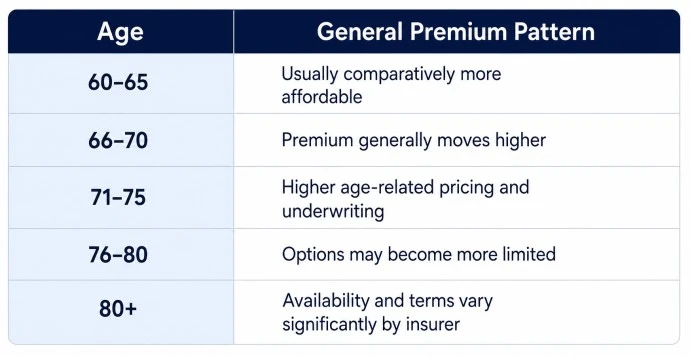
These aren't fixed market prices. Your parent's actual quotation can be different. And remember one more thing: premium isn't the only cost.
Co-payment is also a cost. A policy with a slightly higher premium but a more manageable co-payment can sometimes make more financial sense than a cheaper policy with a large out-of-pocket share.
PM Health Insurance Scheme Above 70 Years: What Parents Should Know
This is probably the most important update for families with parents aged 70+.
Under the expansion of Ayushman Bharat PM-JAY, all senior citizens aged 70 years and above can get the scheme's benefits irrespective of their socio-economic status. Eligible seniors receive an Ayushman Vay Vandana Card.
The cover is up to ₹5 lakh per year under the scheme. There's another useful point that many people don't know.
A senior citizen aged 70+ who already has private health insurance can still be eligible for AB PM-JAY benefits, subject to the scheme's rules. For families already covered under AB PM-JAY, the 70+ senior can receive an additional top-up cover of up to ₹5 lakh for themselves.
The government reported in August 2026 that the Ayushman Vay Vandana expansion covers around 6 crore senior citizens aged 70 years and above. So if your parent recently turned 70, checking eligibility for the scheme should be on your list.
Is Ayushman Bharat Enough for a 70+ Parent?
This is where things become more personal. For some families, government health cover may provide valuable support. For others, particularly those who prefer specific private hospitals or want additional financial protection, private insurance may still be worth considering.
Don't think of it as: Government scheme OR private insurance. Depending on eligibility and circumstances, it can be useful to understand how both forms of protection work.
Also remember that AB PM-JAY operates through its own empanelled healthcare network and scheme rules. Government information states that the Vay Vandana beneficiaries can use the scheme through empanelled hospitals.
So before depending on any cover, find out where your parent can actually use it.
The Things Families Usually Miss
When buying a policy for a parent, the brochure isn't the difficult part. The difficult part is understanding what happens during a claim.
For example, check the room-rent limit. A policy may cover hospitalisation but have a restriction on the room category.
Then there is co-payment. Then waiting periods, especially for pre-existing diseases. Then specific exclusions and sub-limits. And don't forget the hospital network. A company saying it has thousands of cashless hospitals sounds impressive, but the more useful question is:
“Is the hospital my parents would actually visit on that list?” - That's the question that matters at 2 a.m. when you're sitting in an emergency department.
What If Your Parents Already Have a Policy?
This is important enough to say separately: Don't replace an existing policy without comparing it properly. Suppose your parents bought a policy several years ago. The premium may have increased. You may find another insurer offering a cheaper quote.
But the existing policy may already have completed certain waiting periods. If you cancel it and buy a new policy, you may have to deal with the new policy's applicable waiting periods and underwriting conditions.
So before switching, compare the old and new policies side by side. Sometimes the policy you already have is more valuable than you realise.
So, What Should You Do If Your Parent Is Above 70?
Start with the basics. If your parent is 70+, first check their eligibility for Ayushman Vay Vandana.
Then look at their existing private health insurance, if any. If there is no adequate private cover, explore the products available for their age rather than assuming they're too old. And while comparing, don't get distracted by the biggest number on the first page of the brochure. Look at the things that will actually affect a claim: co-payment, waiting periods, exclusions, room-rent limits, hospital network and renewal conditions.
That's what makes a health policy useful.
Frequently Asked Questions
1 Can a 70-year-old get health insurance in India? Yes. Some private health insurance products accept senior citizens at higher entry ages, although acceptance depends on the insurer, product and medical underwriting. Seniors aged 70+ can also be eligible for AB PM-JAY irrespective of income.
2 Can a 75-year-old get health insurance? Yes, it may be possible. The available products and terms can vary significantly at this age, so the insurer's entry-age criteria and underwriting requirements should be checked.
3 What is the PM health insurance scheme for people above 70 years? AB PM-JAY has been expanded to cover senior citizens aged 70 years and above irrespective of socio-economic status. The scheme provides up to ₹5 lakh annual health cover under its applicable rules.
4 Is health insurance for parents above 60 worth buying? It can be very useful because a major hospital bill can put considerable pressure on retirement savings. The right policy depends on your parents' age, health, existing cover and financial situation.
5 How much is senior citizen health insurance premium? There is no single fixed premium. It varies according to age, location, sum insured, health history, policy features and insurer underwriting.
6 Can someone above 80 get health insurance? Possibly. It depends on the individual insurer and product. At higher ages, available options and underwriting conditions can be more restrictive.
7 Can someone with private health insurance also use Ayushman Vay Vandana? Yes. The government has clarified that senior citizens aged 70+ who are covered by private health insurance can also be eligible for AB PM-JAY benefits, subject to the scheme's rules.

5.0
Need advice from experts?
Health is tricky, and insurance trickier. But we’ll simplify it for you — for FREE! Book a call now. Limited slots available!
 Talk to an Advisor

 Talk to an Advisor