
Term Insurance vs Life Insurance
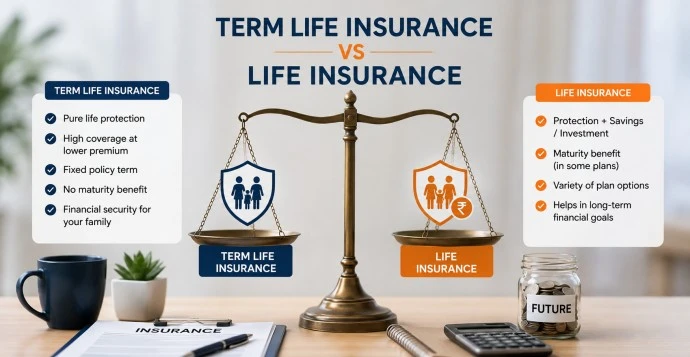
Term Insurance vs Life Insurance
Term Insurance is a type of Life Insurance that focuses purely on financial protection for a fixed period, while Life Insurance is a broader category that also includes plans with savings, investment, or lifelong coverage features. If your main goal is protecting your family's financial future at an affordable premium, Term Insurance is often the option people consider first. If you also want savings or investment benefits, other types of Life Insurance may be worth exploring depending on your financial goals.
Buying insurance can be confusing because almost every policy promises to protect your family. The names sound similar too-term life insurance, life insurance, endowment, whole life, ULIP-and that's where many people get stuck. The truth is much simpler than it looks.
Term Insurance and Life Insurance are not really two opposite products. Term Insurance actually falls under the larger umbrella of Life Insurance. The real difference lies in what each plan is designed to do.
If you're someone trying to understand whether you need pure financial protection or a policy that combines protection with savings, this guide will help you make sense of it without drowning you in insurance jargon.
What Is the Difference Between Term Life Insurance and Life Insurance?
The biggest difference is that Term Insurance focuses mainly on financial protection for a fixed period, while Life Insurance includes different plans that may offer protection along with savings or investment benefits. Here's an easy way to look at it. Suppose two friends decide to buy insurance.
Rahul wants to make sure his wife and parents remain financially secure if he is no longer around. He isn't looking for investment through insurance. His priority is maximum protection within a reasonable premium.
Priya, on the other hand, wants life cover but is also exploring a plan that may help with long-term savings goals. She is willing to evaluate products beyond pure protection. Rahul's needs naturally point toward Term Insurance.
Priya may compare different Life Insurance products depending on her financial objectives. Neither choice is universally better. They simply solve different financial needs.
The table below highlights the key differences between Term Insurance and Life Insurance, making it easier to understand how their purpose, benefits, and suitability
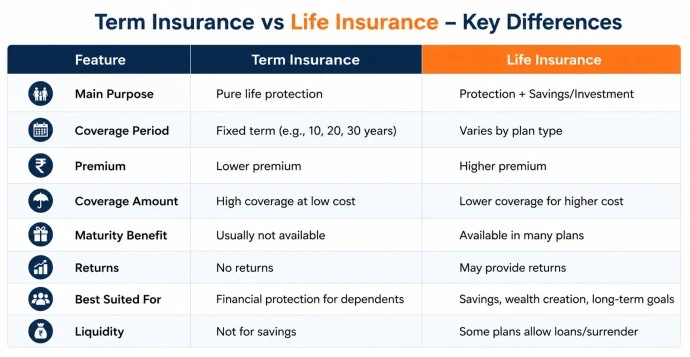
What Is Term Insurance?
Term Insurance is a pure life cover that provides financial protection for your nominee if the insured person dies during the selected policy term, subject to the policy conditions.
Think of Term Insurance as protection for the people who depend on your income.
Imagine you're the only earning member in your family. Your monthly salary pays the rent or home loan, children's school fees, groceries, electricity bills and everything else that keeps the household running.
Now imagine that income suddenly disappears. That's the financial risk Term Insurance is designed to address.
A term plan generally offers a high life cover for a comparatively affordable premium because its primary purpose is protection rather than wealth creation. Many people choose it because they want their family to have financial support if something unfortunate happens during the policy period.
One thing to remember is that a pure Term Insurance policy usually does not provide a maturity payout if you survive the entire policy term, unless you specifically choose a different product variant that includes such benefits. The policy wording always decides what applies.
What Is Life Insurance?
Life Insurance is a broad category of insurance products designed to provide financial protection, and depending on the plan, it may also include savings, investment, retirement, or lifelong coverage features. This is where many people misunderstand the term. They often think Life Insurance and Term Insurance are completely different things. In reality, Term Insurance is one type of Life Insurance.
Other life insurance products may include:
- Endowment plans
- Whole life plans
- ULIPs
- Money-back plans
- Retirement or annuity-linked insurance products
Each one serves a different purpose. For example, an endowment policy may combine life cover with savings, while a ULIP combines insurance with market-linked investment. A whole life plan is structured differently again and focuses on lifelong coverage according to the policy design. So when someone says, “I want Life Insurance,” the next question should really be: What kind of Life Insurance are you looking for?
Is Term Insurance Better Than Life Insurance?
Term Insurance is not automatically better than every Life Insurance plan-it is better suited for people whose main priority is affordable financial protection for their dependents.
This question comes up almost every day because people naturally want to know which policy gives the “best value.”
The answer depends on what you expect from insurance. If your goal is replacing your income for your family in case of an unfortunate event, Term Insurance is often the more straightforward option because it focuses on pure protection.
If your goal includes savings, wealth accumulation or market-linked investment through an insurance product, then other types of Life Insurance may be relevant too. The mistake people make is trying to judge every insurance product using the same yardstick. Insurance isn't one-size-fits-all. A plan designed for wealth creation should not be compared exactly like a plan designed purely for income protection.
Which One Should You Choose?
Choose Term Insurance if your priority is protecting your family's financial future. Consider other Life Insurance plans only when your financial goals also include savings, investment, or other long-term objectives.
A practical decision starts with asking yourself a few honest questions.
Do people depend on your income? Do you have a home loan? Are you planning for children's education? Is your main concern financial security rather than investment? If the answer is yes, then Term Insurance deserves serious consideration.
On the other hand, if you're specifically looking for insurance products that combine life cover with savings or investment features, you can compare different life insurance categories before deciding. The important part is understanding why you're buying the policy, not simply buying the one that sounds more attractive in an advertisement.
Does Life Insurance Give Maturity Benefits?
Some Life Insurance plans provide maturity or survival benefits, while pure Term Insurance plans generally do not offer a maturity benefit unless the product specifically includes one. This is another area where buyers often get confused.
Traditional savings-oriented policies may pay a benefit when the policy reaches maturity, subject to the plan terms.
ULIPs work differently because they include market-linked investments alongside life cover.
Whole life and endowment plans have their own benefit structures as well.
That's why it's always important to read the benefit illustration and policy wording instead of assuming every life insurance policy works the same way.
Can You Buy Term Insurance and Life Insurance Together?
Yes, you can own a Term Insurance policy along with another Life Insurance product if it fits your financial planning and insurance needs.
There's no rule saying you can only have one life insurance policy. Some people prefer keeping protection and investments separate.
For example, they may purchase a Term Insurance policy for family protection while handling savings through other financial instruments. Others may choose additional insurance products based on long-term financial goals.
The important thing is avoiding duplicate or unnecessary coverage without understanding what each policy is doing for you. Every policy should have a purpose.
Things to Check Before Buying Term Insurance
Before purchasing a policy, spend a little time comparing the details that genuinely matter.
1. Sum Assured Choose a life cover after considering your income, liabilities, family expenses and future responsibilities.
2. Policy Term Select a coverage period that matches the years during which your family would financially depend on your income.
3. Premium Payment Options Understand whether the premium payment structure suits your long-term budget.
4. Riders Some policies offer optional riders for accidental death, disability or critical illness. Read their individual conditions carefully.
5. Claim Process Your nominee should know that the policy exists and understand where important documents are kept.
6. Honest Disclosure Always provide accurate medical and personal information while filling out the proposal form. Correct disclosure is an essential part of the insurance buying process.
Common Mistakes People Make
Buying only because the premium is low Premium matters, but adequate protection matters more. Confusing savings with protection
A savings-oriented life insurance plan and a pure Term Insurance plan are designed for different financial objectives.
Ignoring policy wording The brochure looks attractive. The actual policy document tells you what really applies. Not reviewing coverage after major life changes
Marriage, children, loans and increased income are good reasons to revisit your insurance needs. Thinking one policy solves every financial goal
Protection, savings and investment are related financial goals-but they don't always need to be achieved through the same product.
FAQs
1. Is Term Insurance better than Life Insurance? It depends on what you actually need from the policy. If your main concern is making sure your family has financial support if you are no longer around, Term Insurance can be a practical choice. Other Life Insurance plans may make more sense if you also want savings-related benefits.
2. Is Term Insurance cheaper than Life Insurance? In most cases, Term Insurance costs less for a similar amount of life cover. The reason is fairly simple: a regular term plan focuses on protection rather than combining insurance with savings or investment features.
3. Can I have Term Insurance and another Life Insurance policy? Yes, you can have both. They don't necessarily have to serve the same purpose. For instance, you could use Term Insurance mainly to protect your family's income while having another Life Insurance plan for a separate long-term financial goal.
4. Do I get money back when my Term Insurance policy ends? Usually, no-not with a standard Term Insurance plan. If you remain covered until the end of the policy term, there is generally no maturity payout. Some plans can have different features, though, so check the policy details before buying.
5. Who should consider buying Term Insurance? Term Insurance is worth considering if someone depends on your income. It can be especially relevant if you have a spouse, children, ageing parents, a home loan or other financial responsibilities. The idea is simple: if your income stops unexpectedly, the policy can provide financial support to your nominee, subject to the policy terms.

5.0
Need advice from experts?
Health is tricky, and insurance trickier. But we'll simplify it for you — for FREE! Book a call now. Limited slots available!
 Talk to an Advisor

 Talk to an Advisor